

Share this content:
What happens to a society when convenience becomes the doorway to control? What becomes of a human being when every click, pause, preference, and weakness is measured, modeled, and monetized? These are not merely technological questions. They are moral questions. They are spiritual questions. And if we are honest, they are questions about power.
We are living in an age where personal history is no longer simply remembered; it is harvested. What some scholars describe as surveillance capitalism is the conversion of human experience into usable data, then into predictive products, and finally into influence. Shoshana Zuboff argues that private human experience is being treated as raw material for behavioral prediction and modification, not merely for service improvement but for profit and control.
So, let us ask the question plainly: if your memories, habits, fears, cravings, and routines can be translated into a market asset, where exactly does your freedom begin? And if institutions know more about your impulses than you do, is that still a marketplace, or is it a soft architecture of domination? The issue is not only privacy. The issue is asymmetry. Somebody is watching, learning, testing, and adjusting, while the average person is told to just click “accept” and keep moving.
This is the great imbalance of our time: a widening gap between those who gather knowledge and those who are gathered by it. One side accumulates insight, leverage, and behavioral power. The other side offers up life in fragments, often without full awareness of what has been taken. That is not informed participation. That is dependence dressed up as personalization.
The Quiet Erosion of Autonomy
The next question is even more unsettling: what if the system does not merely observe your choices, but slowly conditions them? Algorithms do not simply organize information. They prioritize emotion, amplify urgency, reward reaction, and build separate realities around each individual. The result is not just customized content; it is customized perception. What you see, what you fear, what you resent, and what you believe can all be shaped by systems optimized for engagement rather than truth.
The Center for Humane Technology describes the attention economy as a system designed to exploit human vulnerability. That means the struggle before us is not just political or technological. It is deeply human. Can a people remain morally centered when outrage is profitable? Can communities remain coherent when each person is handed a different version of reality? Can democracy survive when division is not an accident of the system but one of its most reliable outputs? These are rhetorical questions, yes, but they press on real wounds.
In the voice of balance, I would say this: any machine that feeds on your attention but starves your discernment is not serving your freedom. Any platform that deepens compulsion while weakening reflection is not neutral. And any digital order that replaces wisdom with stimulation will eventually leave people informed in fragments but hollow in spirit.
So, what is the answer? It begins with recovering moral agency. We must learn again to pause before we react, to question what flatters our bias, to protect the inner life from systems that profit from agitation. Balance is not passivity. Balance is disciplined awareness. It is the refusal to let convenience become captivity.
Theoretical though this question may be, its lesson is practical: if we do not guard the boundaries of the mind, someone else will map them, sell them, and attempt to govern them. And when that happens, the loss is not only private. The loss is civic, relational, and spiritual.
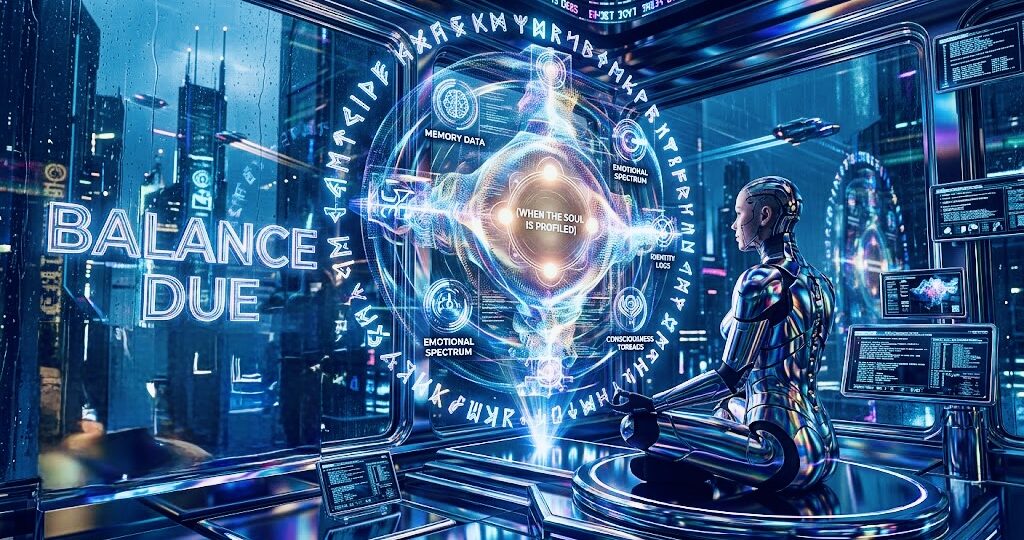
Here at Balance Due, we return to the same essential conviction: a society without balance will mistake access for wisdom, speed for truth, and visibility for value. But the human spirit was not made to be reduced to metrics. It was made for conscience, clarity, and connection. So, the question remains: will we continue to be shaped by systems we barely understand, or will we reclaim the courage to live as more than data points? That balance, now more than ever, is due.
Join the Balance Due community
Join and get The Cost of Me: Finding Equilibrium free, a 14-page illustrated report, plus new articles and encouragement for care professionals.
We respect your privacy. Your email is only used for Balance Due updates, and you can unsubscribe at any time.
RELATED POSTS
View all


The True Cost of Targeted Layoffs: A Human Perspective
September 21, 2025 | by rodney
Martin Luther King Jr’s Ultimate Sacrifice
January 19, 2026 | by rodney